Careers · Gig & Field Work
Need Money Now? How to Use Gig Work Without Losing Your Plan
You've finished 12th, a diploma or a degree. You've moved to a new city or town. Rent is due, and the right job hasn't come yet — or you're preparing for an exam or course and need income that fits around it.
Gig work can help. This guide shows how to use it well, and how to make sure it stays a stepping stone rather than quietly replacing the plan you came to the city to pursue.
Some gig work can provide income relatively quickly, and some forms offer flexible working arrangements. Use it deliberately by doing three things:
- Enter at the highest level your current skills allow.
- Protect the time you have set aside for your real goal.
- Build one skill that can move you toward the next level.
Gig work becomes a problem when the work needed to earn today's money steadily consumes the time and energy needed to build tomorrow's options.
Is this guide for you?
It is, if you are 18 or older and one of these sounds like you:
- "I've just moved and I need money this month."You came to a city for a job search, a course, or family reasons, and you need rent and food money before anything else works out.
- "I'm still figuring out my career."You don't want to grab the first full-time job out of panic without thinking about where it leads.
- "I'm preparing for something else."A government exam, an entrance test, a course, a skill — and you need income that bends around your preparation, not the other way round.
Most gig platforms require workers to be at least 18. Riding and driving work also requires the relevant driving licence and other vehicle documents.
Gig work can be understood as a pyramid — not just delivery
When most people hear "gig work", they picture a delivery bag or a bike taxi. That is real work — but it is only one part of the picture.
The Enaasan Gig Work Skill Pyramid
An Enaasan framework for understanding different types of gig and field work. It is not a fixed industry-wide career ladder.
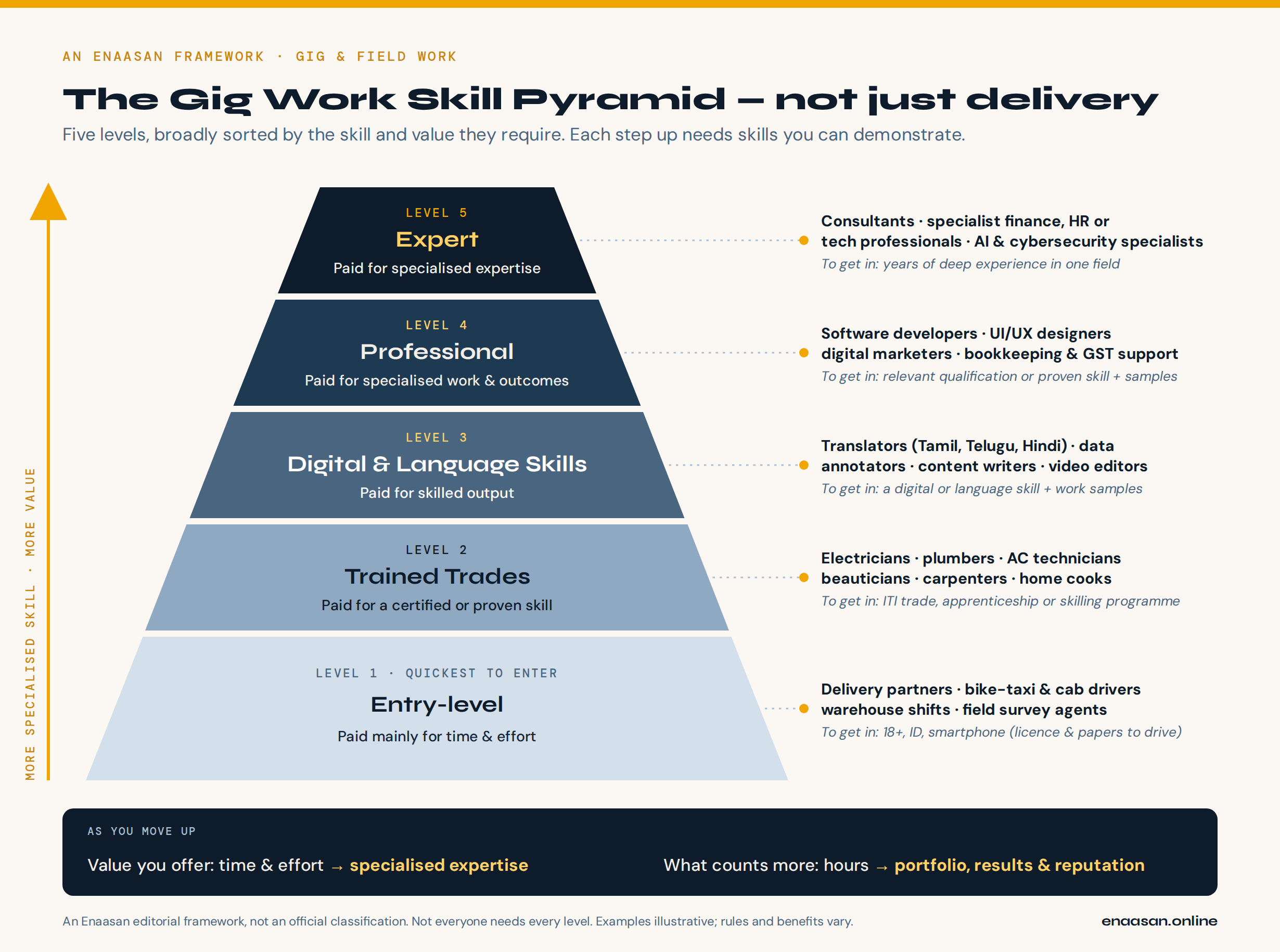
Five levels, broadly sorted by the skill and value they require. Each step up needs skills you can demonstrate.
- Level 1 — Entry-level. Paid mainly for time and effort.
Delivery, bike-taxi and cab driving, warehouse shifts, field surveys. - Level 2 — Trained trades. Paid for a certified or demonstrated practical skill.
Electricians, plumbers, AC technicians, beauticians, carpenters, home cooks. - Level 3 — Digital and language skills. Paid for skilled output.
Translation, data annotation, content writing, video editing, online tutoring. - Level 4 — Professional. Paid increasingly for specialised work and outcomes.
Software development, UI/UX design, digital marketing, bookkeeping, GST support, tax documentation. - Level 5 — Expert. Paid increasingly for specialised judgment and expertise.
Consultants, specialist finance/HR/technology professionals, AI and cybersecurity specialists, specialist trainers.
As you move upward, the value you offer generally shifts from time and physical effort toward specialised skills, outputs, outcomes and eventually expertise. Your portfolio, demonstrated results and reputation can become increasingly important.
Not every person needs to move through every level. The purpose of the pyramid is to help you see where your current skills fit and what you could build next.
Which level can you enter this week?
Start from what you already have.
| If you have… | You can usually start at… | Worth trying on the side |
|---|---|---|
| 12th pass | Level 1 — delivery, riding, warehouse or field work | Level 3, if you are strong in a language (translation, transcription in your mother tongue) or comfortable on a computer |
| ITI or diploma | Level 2 — work in your own trade (electrical, mechanical, AC, plumbing) | Level 3 digital tasks, if you have the skills |
| Graduate | Level 3 — content, data work, tutoring in your subject | Level 4, if your degree is relevant and you can demonstrate the professional skill through samples or qualifications |
Level 1 work may be easier to enter quickly because the entry requirements can be simpler. Higher-skill work can take longer to land because clients may expect qualifications, samples, experience or demonstrated results.
That is why some people use both: immediate income now, while building a higher-value skill on the side.
That combination is the stepping stone in action.
Before your first shift: what you'll need
Depending on the work and platform, you may need:
- Aadhaar and PAN
- A bank account in your name, with UPI
- A smartphone with a reliable data plan
- For riding or driving: driving licence, vehicle RC and insurance
- For trades: your ITI or diploma certificate, and basic tools
- For digital work: an email ID and two or three samples of your work
- Your current address details in the new city if the platform requires them
Requirements differ between platforms, occupations and cities.
💡 Check the platform's official app or website — not a WhatsApp forward.
Read the earnings claim honestly
Ads say "earn up to…"
Treat "up to" as a ceiling or promotional claim, not as a promise of what you will normally earn.
− fuel − vehicle costs − phone and data − any platform fees or rentals ÷ all the hours you were logged in, including waiting time
Ask before you join:
- Is the "up to" figure based on full-time hours, peak hours, or weekends only?
- Are incentives tied to targets — a number of orders or trips — that you may not reach?
- Who pays for fuel, repairs, and a damaged phone?
- How often do payouts come — daily or weekly?
- Is there a deposit for a bag, uniform or kit? Is it refundable?
Track your real hourly earning for two weeks before you decide whether a platform or type of work is worth continuing.
Protect your time: the part-time rule
If gig work is meant to support your real goal, your real goal gets scheduled first.
- Set your weekly hour limit. Decide it before you log in, not in the middle of a busy shift.
- Block your important hours first. Put your study, course or job-search hours into your calendar first. Gig hours fill the gaps around them — not the other way round.
- Pick your shifts deliberately. Busy hours — mealtimes, evenings, weekends — may pay differently on different platforms. Check that they do not clash with the hours when you need your best concentration for study or job preparation.
- Watch the incentive trap. Targets can encourage you to stay online longer. "Complete a few more orders to unlock your bonus" may be worth doing sometimes. But decide deliberately rather than letting the target decide your working hours for you.
- Rest. Riding tired is dangerous. No payout is worth an accident.
Your safety net: set it up in week one
Gig and platform work can have different benefit and social-security arrangements from conventional salaried employment. India's current social-security framework recognises gig and platform workers, and governments are developing and implementing schemes for them. The benefits available to a particular worker depend on the applicable law, scheme, work arrangement and eligibility.
Start with these checks:
Some platforms may provide accident or health insurance or other protections. Read what is actually covered, who is eligible and how a claim works.
The Union Budget 2025–26 announced identity cards and registration of online platform workers on e-Shram and healthcare under Ayushman Bharat–PM Jan Arogya Yojana (PM-JAY). Implementation has been progressing through the Ministry of Labour and Employment and participating systems.
Check the official e-Shram and government portals for what is currently available and whether you qualify.
Under Pradhan Mantri Suraksha Bima Yojana (PMSBY), eligible savings-account holders aged 18–70 can obtain accident insurance subject to the scheme's current terms and premium. Ask your bank and check the official scheme information.
States are developing their own measures for gig and platform workers.
Rajasthan enacted gig-worker legislation in 2023. Karnataka, Bihar and Jharkhand followed in 2025, and Telangana in 2026. The details, implementation and benefits vary.
Check your state labour department for the current rules that apply to you.
Even a little saved each week helps when the bike breaks down, work slows down or an unexpected expense arrives.
Try the work for a few weeks first if possible.
A loan can turn a flexible income source into an obligation you cannot easily leave.
Stepping stone or trap? Your 90-day check
Ninety days after you start, sit down and answer honestly.
- You're covering your costs and saving at least a little
- Your study, course or job search is on track
- You've started building one skill for the next level
- You understand your real hourly earning
- You still have a clear next step
- Months have passed and you haven't started any new skill
- You're working more hours just to earn roughly the same money
- Your preparation time keeps shrinking
- You've taken on debt mainly to keep doing the work
- You no longer have time or energy for the goal that brought you there
If it is becoming a problem, you don't necessarily have to quit immediately.
Change one thing: Cut the hours. Or book the course. Or start the skill.
Each step up needs something you can prove.
Possible progression
- Level 1 → Level 2: An ITI trade, apprenticeship or relevant skilling programme.
- Level 2 → Level 3: A digital or language skill, plus work samples.
- Level 3 → Level 4: Deepen one skill to professional standard, build a portfolio, or earn a relevant qualification.
The exact route depends on the occupation.
Watch out for scams
- Never pay just because someone promises you a job. Be extremely cautious if someone asks you to pay a registration, joining or recruitment fee before giving you work. Verify the opportunity directly through the platform's official website or app.
- Ignore "easy money" task offers. Be especially cautious about "like videos and earn", "rate hotels and earn" and similar offers received through WhatsApp or Telegram. Some scams begin with a small payment and then ask you to transfer or "invest" money.
- Protect your financial credentials. Never share an OTP or UPI PIN with someone who contacts you about a job. Do not give banking credentials to an unknown recruiter or platform representative.
- Download apps carefully. Use the official app store and check the developer/company name. When in doubt, start from the company's official website and follow its app link.
- If you are cheated: for cyber financial fraud in India, call 1930 quickly and report the incident through the National Cyber Crime Reporting Portal.
What to do next
Sources and verification
Rules, schemes, eligibility and platform terms can change. Verify important decisions with the current official source.
- e-Shram registration and platform-worker benefits: e-Shram and Ministry of Labour and Employment
- Social-security framework for gig and platform workers: Code on Social Security, 2020 and Ministry of Labour and Employment
- PM-JAY for eligible platform workers: Ministry of Labour and Employment / National Health Authority
- PMSBY accident insurance: Department of Financial Services / Jan Suraksha
- State gig-worker laws: your state labour department and current state legislation
- Cyber fraud: National Cyber Crime Reporting Portal, helpline 1930
- Background: NITI Aayog, India's Booming Gig and Platform Economy (June 2022)
Editorial note
The five-level Gig Work Skill Pyramid is an Enaasan editorial framework, created to help young people think about gig work in terms of current capability, demonstrable skills and possible next steps. It is not an official government or industry classification.
The examples are illustrative. Actual entry requirements, platform rules, payouts, incentives, insurance, documentation and work availability vary by company, occupation and location.
Enaasan informs decisions; it does not make them. This guide does not recommend any specific platform.